About
My practice is immediate and spontaneous, a direct connection with life as it is experienced, and as engaged with time as with space, people and place.
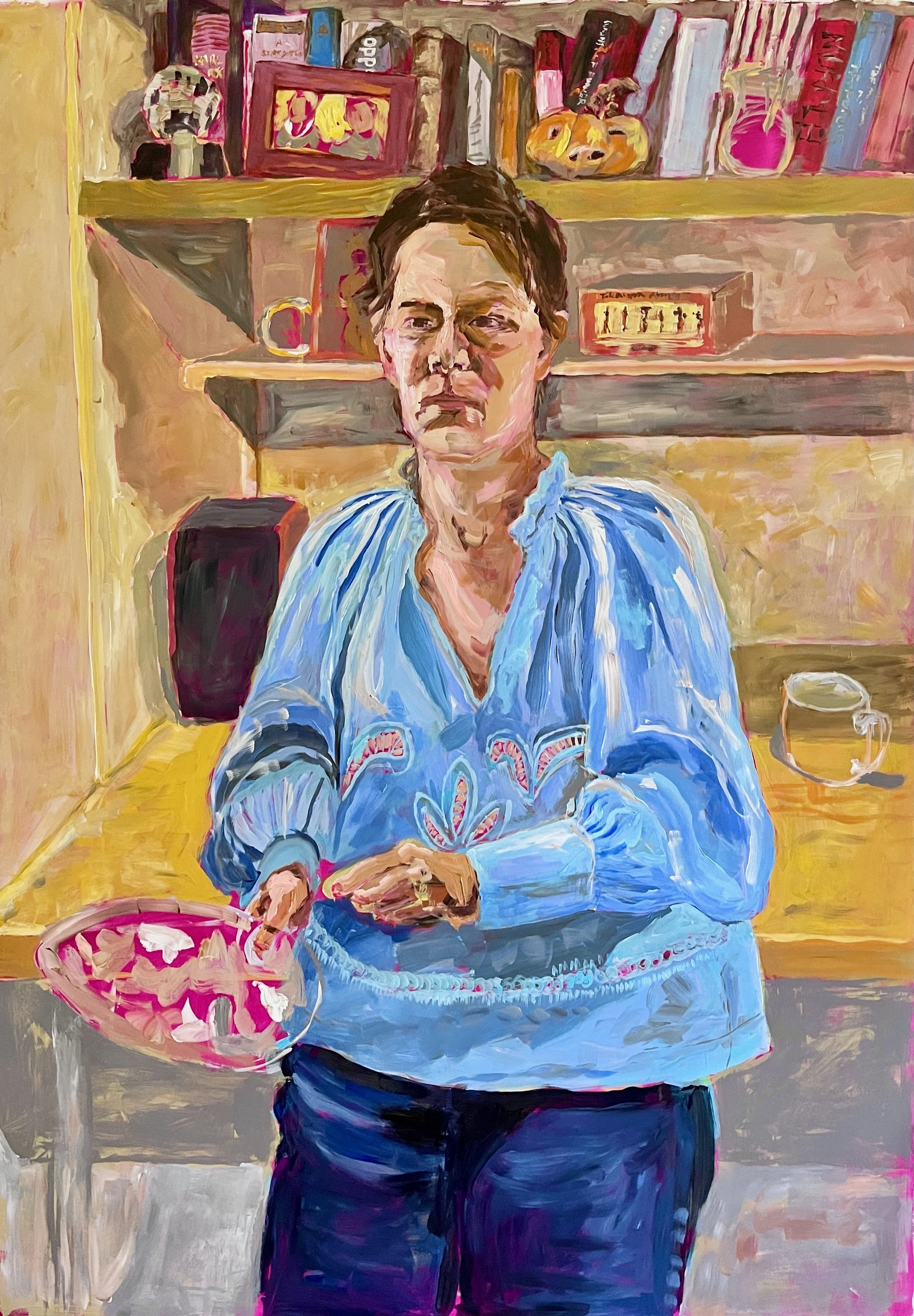
I paint experience rather than appearance and I try to be honest about what I see and feel, and about how the painting is made. Brushstrokes and grounds are exposed, the process visible. Vivid, clashing colours disrupt and energise the surface, pushing through into the everyday scene.
Every painting is rooted in observation and my own experience. I am looking for the cracks in the everyday: moments of strangeness and celebration, humour and sadness, beauty and crisis, the surreal, the sinister.
What do people do during periods of upheaval? I'm working on capturing that. My subjects are family, friends and strangers, anyone near me. What is happening while I paint is integral to my practice, whether or not it is the direct subject of the painting.
I paint everyday and everywhere: outside, inside, on the go in a car, on a train, on a plane, on the beach, by the river. I paint with acrylics on stone paper, which I find completely smooth, welcoming the paint and allowing texture, no resistance.
I am based in the UK and also spend time in Canada. Exhibitions include the Society of Women Artists 165th Annual Show (2026), the Royal Birmingham Society of Artists Summer Show (2026), The Leeds Summer Show (2025) and Bath Open (2025).
One Thousand Words on Paint
After two years of painting every day, I want to reflect on the experience and in particular the material experience.
Before I painted, I drew, for two years, everyday, in pencil, crayon, pastel, charcoal. A variety of media, but all with one thing in common. Holding a pencil or a piece of charcoal is adjacent to writing. Controlling the line feels natural. It goes where you want it to go.
Paint disrupts that in two ways. One is the brush. You don't have to use one - Rose Wylie, whose painting is as immediate as it is direct, has set aside her brush in some of her most recent work and paints with her hands. The other is the paint itself. It's liquid. It can be gloopy, watery, thick. It doesn't behave like a crayon or a pencil. It moves and changes after you've put it down, changes state from liquid to solid. It is much harder to control or to anticipate.
That isn't to say drawing is easy. Working back from the control of drawing, learning to make marks that are expressive rather than written or diagrammatic, is its own difficulty. But paint varies so much, from the chalkiness of gouache to the pastiness of heavy acrylic, that the whole process is thousands of times less controlled. I mostly use water-based paints: watercolour, gouache, acrylic. With all of them, I have much less control than I did with a pencil.
I was talking to someone who told me they don't paint anymore. They couldn't get past the disappointment between what they saw in their head, what they imagined they would paint, and what they actually painted.
Yes, what you see isn't what you get. But if you can accept that, the material gives you so much in return. The challenge of finding out what you can make it do, all the permutations of using it in different ways. The surprise that although it isn't what you expected, it's something else, something good, and you're the one who made it, so you have to decide what to do with the thing that has appeared.
I was watching Cecily Brown talk about knowing when a painting is finished. She said it can take months, and the longer you've worked on something, the more months of work the more there is at stake when you make changes. Sometimes the thing you've been holding onto as most important is exactly what has to change, so it can be tough. She talked about risk taking. Sometimes it doesn't work out, and you have to accept that too. Her main interest as an artist is in seeing how far she can push paint, and that's a useful thing to hold onto when you're thinking about the material itself.
Working with something unpredictable teaches you that what you see and what you get are different, and it builds what the artist Christopher Mooch, quoting the book Art & Fear, calls a tolerance of uncertainty. Which is an interesting thing to have in life in itself. Making art takes courage, and paint takes more of it than drawing ever did, at least for me. The painting process brings together expression, observation, imagination, danger, choice, uncertainty - it’s elating, and there's something addictive in it.
That’s painting. But what is paint?
The first paint I used as a child in the 1970s was called ‘powder paint’. It came in small tins, and contained powdered pigment that you added water to and mixed into paint - you can still get it, but I don't see it used very often. It shows what paint is - powder, pigment. Put simply, paint is just colour in different forms.
Painting, then, is working with an unpredictable, hard to control form of colour, which you use to make art.
I saw a quote today from the American novelist William Faulkner, in which he says the only use for art is as an occupation for artists. It's a funny line, but what if it were true? It would still be a wonderful occupation, and a wonderful experience.
When I paint, I lay a layer of colour across the whole page first, and I choose the colour depending on what I'm painting, I’ve heard this layer is called the ‘ground’. I once read a simple principle: if you're painting a person, the most important colours are the flesh tones, which are warm, so the ground underneath needs to clash against that warmth. Blue, the coldest colour. If you're painting nature, the important colours are greens and blues, which are cold, so the ground should be a hot colour to make the cold come alive. Red, the hottest colour.
The subject of the painting then takes its definition against its opposite, which makes it clearer and stronger. Sometimes painting green over red makes me so excited and happy that it gives me a thrill which is just what happens, I can’t tell you why. And when I paint a person over blue, their skin resonates against it (not always because skin tones are a challenge for me and a lot of people, and sometimes it looks dull and deadly). You can see the principle at work in medieval art and icons, where blue was used to show Mary as pure and holy, she might have a blue halo, making her seem radiant.
Radiant is the right word, because colour is only light, reflected back out in different wavelengths. I guess when we mix paints we are changing or tuning the wavelength.
These days I use many different colours beneath my paintings, not just red and blue, and I find some are harder to paint over than others. Bright, cold yellow is particularly tricky.
The one I can't use anymore is white. I can't make a painting work over a white page. Maybe it's because white reflects everything, and repels every colour in return. I'm not sure, but if paint is colour, and colour is light, then painting is playing with light.